
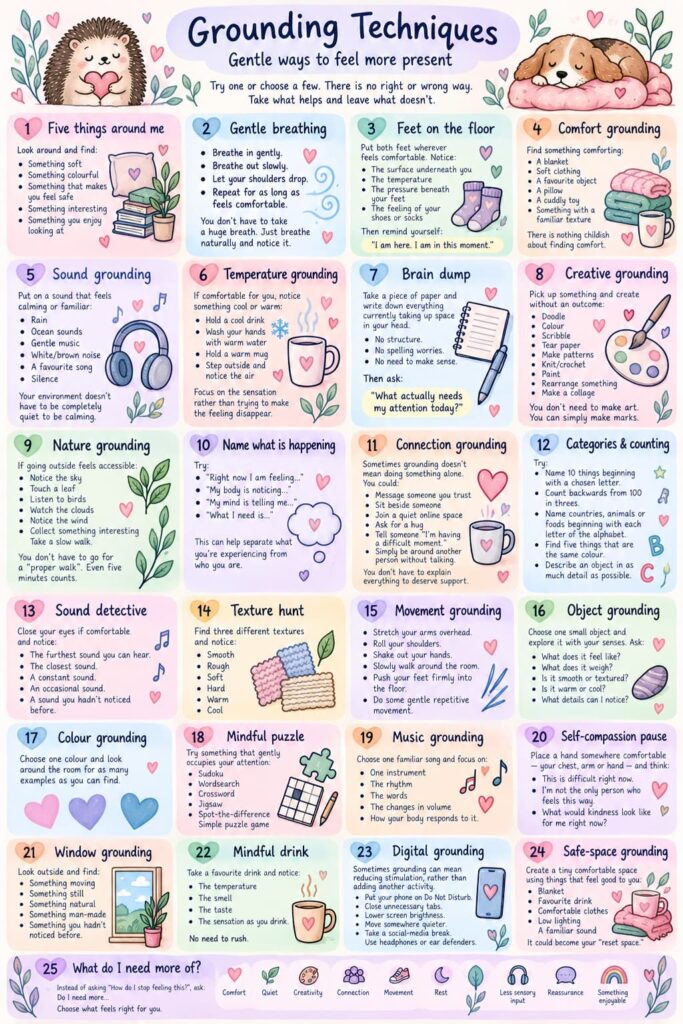
Grounding Techniques
Sometimes when everything feels a little too much, grounding can help bring your attention back to the present moment.
There is no right or wrong way to do this. You can try one idea, choose a few, or leave anything that doesn’t feel comfortable for you.
Take what helps and leave what doesn’t.
Five things around me
Look around and find:
- Something soft
- Something colourful
- Something that makes you feel safe
- Something interesting
- Something you enjoy looking at
Gentle breathing
Rather than trying to follow a strict breathing pattern, simply notice your breathing.
Breathe in gently.
Breathe out slowly.
Let your shoulders drop.
Repeat for as long as feels comfortable.
You don’t have to take a huge breath. Just breathe naturally and notice it.
Feet on the floor
Put both feet wherever feels comfortable and notice:
- The surface underneath you
- The temperature
- The pressure beneath your feet
- The feeling of your shoes or socks
Then gently remind yourself:
“I am here. I am in this moment.”
Comfort grounding
Find something comforting, such as:
- A blanket
- Soft clothing
- A favourite object
- A pillow
- A cuddly toy
- Something with a familiar texture
There is nothing childish about finding comfort.
Sound grounding
Put on a sound that feels calming or familiar:
- Rain
- Ocean sounds
- Gentle music
- White or brown noise
- A favourite song
- Silence
Your environment doesn’t have to be completely quiet to be calming.
Temperature grounding
If comfortable for you, notice something cool or warm:
- Hold a cool drink
- Wash your hands with warm water
- Hold a warm mug
- Step outside and notice the air
Focus on the sensation rather than trying to make the feeling disappear.
Brain dump
Take a piece of paper and write down everything currently taking up space in your head.
No structure.
No spelling worries.
No need to make sense.
Then ask yourself:
“What actually needs my attention today?”
Creative grounding
Pick up something and create without needing an outcome.
You could:
- Doodle
- Colour
- Scribble
- Tear paper
- Make patterns
- Knit or crochet
- Paint
- Rearrange something
- Make a collage
You don’t need to make art. You can simply make marks.
Nature grounding
If going outside feels accessible:
- Notice the sky
- Touch a leaf
- Listen to birds
- Watch the clouds
- Notice the wind
- Collect something interesting
- Take a slow walk
You don’t have to go for a “proper walk”. Even five minutes counts.
Name what is happening
Try completing one of these sentences:
- Right now I am feeling…
- My body is noticing…
- My mind is telling me…
- What I need is…
This can help separate what you’re experiencing from who you are.
Connection grounding
Sometimes grounding doesn’t mean doing something alone.
You could:
- Message someone you trust
- Sit beside someone
- Join a quiet online space
- Ask for a hug
- Tell someone, “I’m having a difficult moment.”
- Simply be around another person without talking
You don’t have to explain everything to deserve support.
Categories & counting
You could try:
- Naming 10 things beginning with a chosen letter
- Counting backwards from 100 in threes
- Naming countries, animals or foods beginning with each letter of the alphabet
- Finding five things that are the same colour
- Counting the objects around you
- Describing one object in as much detail as possible
Sound detective
Close your eyes if comfortable and notice:
- The furthest sound you can hear
- The closest sound
- A constant sound
- An occasional sound
- A sound you hadn’t noticed before
Pattern grounding
Draw repetitive shapes, spirals, lines or patterns.
There is no finished picture. Just follow the next line.
Texture hunt
Find three different textures and notice whether they feel:
- Smooth
- Rough
- Soft
- Hard
- Warm
- Cool
Movement grounding
You could:
- Stretch your arms overhead
- Roll your shoulders
- Shake out your hands
- Slowly walk around the room
- Push your feet firmly into the floor
- Do some gentle repetitive movement
Object grounding
Choose one small object and explore it with your senses.
Ask:
- What does it feel like?
- What does it weigh?
- Is it smooth or textured?
- Is it warm or cool?
- What details can I notice?
Colour grounding
Choose one colour and look around the room for as many examples as you can find.
Mindful puzzle
Try something that gently occupies your attention:
- Sudoku
- Wordsearch
- Crossword
- Jigsaw
- Spot-the-difference
- A simple puzzle game
Music grounding
Choose one familiar song and focus on:
- One instrument
- The rhythm
- The words
- Changes in volume
- How your body responds to it
Self-compassion pause
Place a hand somewhere comfortable — your chest, arm or hand — and think:
This is difficult right now.
I’m not the only person who feels this way.
What would kindness look like for me right now?
Window grounding
Look outside and find:
- Something moving
- Something still
- Something natural
- Something man-made
- Something you hadn’t noticed before
Mindful drink
Take a favourite drink and notice:
- The temperature
- The smell
- The taste
- The sensation as you drink
There is no need to rush.
Digital grounding
Sometimes grounding can mean reducing stimulation rather than adding another activity.
You could:
- Put your phone on Do Not Disturb
- Close unnecessary tabs
- Lower the screen brightness
- Move somewhere quieter
- Take a social-media break
- Use headphones or ear defenders if helpful
Safe-space grounding
Create a small comfortable space using things that feel good to you.
You might include:
- A blanket
- A favourite drink
- Comfortable clothing
- Low lighting
- A familiar sound
It could become your own little reset space.
What do I need more of?
Instead of asking, “How do I stop feeling this?”, try asking:
Do I need more…
Comfort?
Quiet?
Creativity?
Connection?
Movement?
Rest?
Less sensory input?
Reassurance?
Something enjoyable?
Choose whatever feels right for you.

Create & Chatter resources are intended for general information and wellbeing support. They do not replace professional medical advice, diagnosis, treatment or mental health support. Please choose what feels right for you and seek professional support if you are concerned about your physical or mental health.
Need more support? View UK helplines and support →